
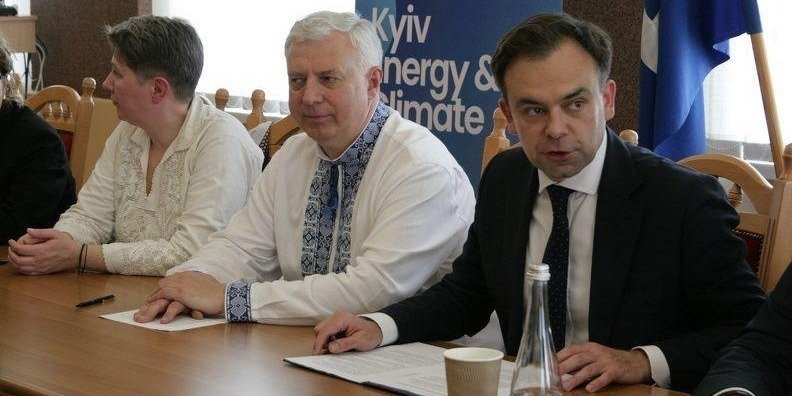
A new phase of energy cooperation between Poland and Ukraine has commenced, following an agreement signed in Kyiv by Forum Energii, the Institute of Environmental Protection – National Research Institute, and the AGH University of Science and Technology in Kraków with the National University of Kyiv-Mohyla Academy. The initiative received the patronage of Mr. Andrzej Domański, Minister of Finance and Economy, who participated in the signing ceremony. The event took place during a Polish economic mission of the energy sector to Kyiv, focused on energy security and transformation.
The reconstruction of Ukraine is not merely an infrastructural process; it is equally an investment in the security, resilience, and economic stability of the entire region. European energy security should be predicated on the diversification of energy sources, modern infrastructure, robust regional cooperation, and profound knowledge and competencies. Poland aspires to be an active partner for Ukraine, not only during its reconstruction but also in the creation of a modern, resilient, and competitive energy system for the future. Today's agreement demonstrates that the collaboration between academia, administration, and experts can establish a tangible foundation for a long-term partnership between our nations and serve as one of the pillars of economic development and security in Central and Eastern Europe
— stated Andrzej Domański, Minister of Finance and Economy.
Kyiv-Mohyla Academy is highly involved into the academic dialog with Polish institutions. At the same time the focus of today’s meeting was the launching the trilateral collaboration between Ukraine, Germany, and Poland in the spheres of energy and climate. This cooperation emerged a year ago with the support of the Ministry of Education and Science of Ukraine and the Joint Ukrainian-German Working Group on Science and Technology, held in Warsaw, was concentrated on the launch of the NaUKMA Kyiv Energy and Climate Lab research center in a cooperation with Helmholtz-Zentrum Berlin. We are happy that three Polish institutions – think tank Forum Energii, The Institute of Environmental Protection – National Research Institute, and Stanisław Staszic Mining and Metallurgical Academy in Kraków – joined this valuable partnership
— commented Professor Serhiy Kvit, Rector of the National University of Kyiv-Mohyla Academy.
For KECLab, today’s agreement matters because Ukraine’s energy and climate transition is no longer a niche expert topic. It is about security, reconstruction, competitiveness, and EU integration. And if Ukraine is to be resilient, we need institutions that can work across disciplines and borders. KECLab was created to give Ukraine an institutional, evidence-based home for this work: a place where research, education, modelling, and policy advice come together. With Helmholtz Zentrum Berlin and now our Polish partners from Forum Energii, IOŚ-PIB, and AGH University of Krakow, this home becomes a stronger trilateral platform connecting Ukraine, Germany, and Poland. The signed MoU gives us the framework; now KECLab is ready to do its part and turn it into joint research, education, and practical outputs for Ukraine’s energy resilience, climate transition, and European future
— added Vladyslav Mikhnych, Director of KECLab.
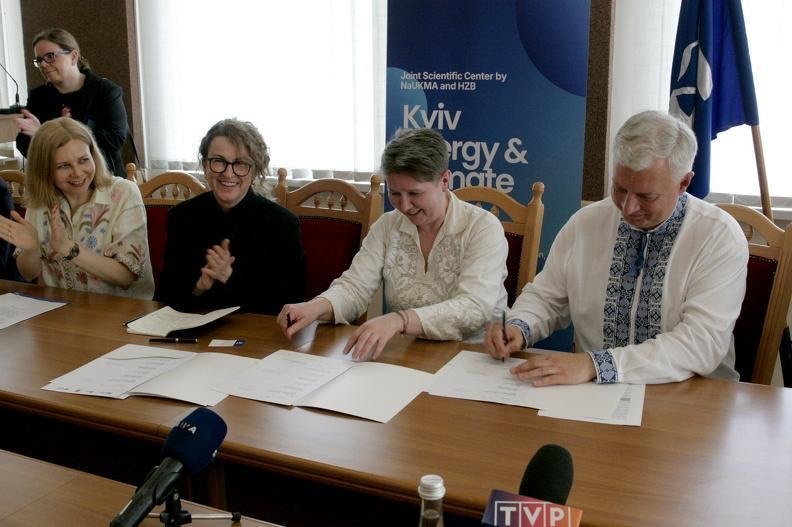
n the photo, from left to right: Olha Poliukhovych (Vice President for Research and Academic Affairs, National University of Kyiv-Mohyla Academy), Joanna Pandera, PhD (President of Forum Energii), Larysa Chovnyuk (Vice President for International Cooperation, National University of Kyiv-Mohyla Academy), Profesor Serhiy Kvit (President, National University of Kyiv-Mohyla Academy)
Ukraine, as a close neighbor of Poland, is an important economic partner. Despite the ongoing Russian invasion, the significance of our cooperation will grow – in the context of reconstruction, developing relations, and the return to peace. The signing of this energy agreement is an important, symbolic moment for me. I am delighted that leading Polish scientific institutions, the Institute of Environmental Protection and the AGH University of Science and Technology, are joining us, and that Minister Andrzej Domański has supported this endeavor. Together with the Kyiv Energy and Climate Lab, we are already working on concrete projects in energy cooperation
— added Joanna Pandera, President of Forum Energii.
Since its inception, AGH has understood its mission as serving society and the economy. In this spirit, we approach the cooperation with NaUKMA and KECLab with great hope. We believe that joint research, knowledge exchange, and the development of analytical tools will enable us to formulate practical solutions that enhance the resilience of local energy systems and help ensure communities continuous access to essential energy services, even during sudden power outages
— emphasized Dr. Artur Wyrwa, Associate Dean for Cooperation and Science at the Faculty of Energy and Fuels, AGH.
We consider supporting Ukrainian scientists and the public sector in building robust foundations for environmental policy to be a pivotal element of assisting Ukrainian society and its economy, which after the war will largely redefine their developmental and environmental objectives. The Institute possesses many years of experience in supporting the Polish administration in implementing climate, air, and developmental policies, which it wishes to share with our Ukrainian partners. We also recognize that our Ukrainian partners possess unique knowledge in Europe and tragic, yet invaluable, experience in building the resilience of environmental protection and energy systems, from which we ourselves can learn a great deal
— commented Dr. Marcin Stoczkiewicz, Director of the Institute of Environmental Protection – National Research Institute.
- Forum Energii – an interdisciplinary think tank operating in the areas of energy, energy security, and climate transformation.
- Institute of Environmental Protection – National Research Institute – a state research institution supporting public administration in climate and environmental policy.
- AGH University of Science and Technology in Kraków – one of Poland's foremost technical universities, conducting research and educational activities in the fields of energy and new technologies.
- National University of Kyiv-Mohyla Academy – one of Ukraine's leading research universities.
- Scientific Center of NaUKMA ‘Kyiv Energy and Climate Lab’ – a joint initiative with Helmholtz-Zentrum Berlin (HZB): KECLab is a scientific center working at the intersection of energy and climate, bringing together academic expertise, international research cooperation, education, and policy-oriented analysis. It supports evidence-based decisions on Ukraine’s energy resilience, climate transition, recovery, and EU integration.